

Pipeline Operations Platform
A custom-built application that scales with the business
Client details have been withheld under NDA throughout this case study.
I led design on a ground-up build that turned a rigid, dated legacy platform into an application people across the company can rely on. Before this, people either built workarounds outside the legacy platform or missed features altogether. I shared product and project management on this year-long project with the front-end lead, owning the client relationship, defining scope, running requirements gathering, and setting the timeline for the work. I led the design work alone, end to end, from research through quality assurance and handoff.
Problem
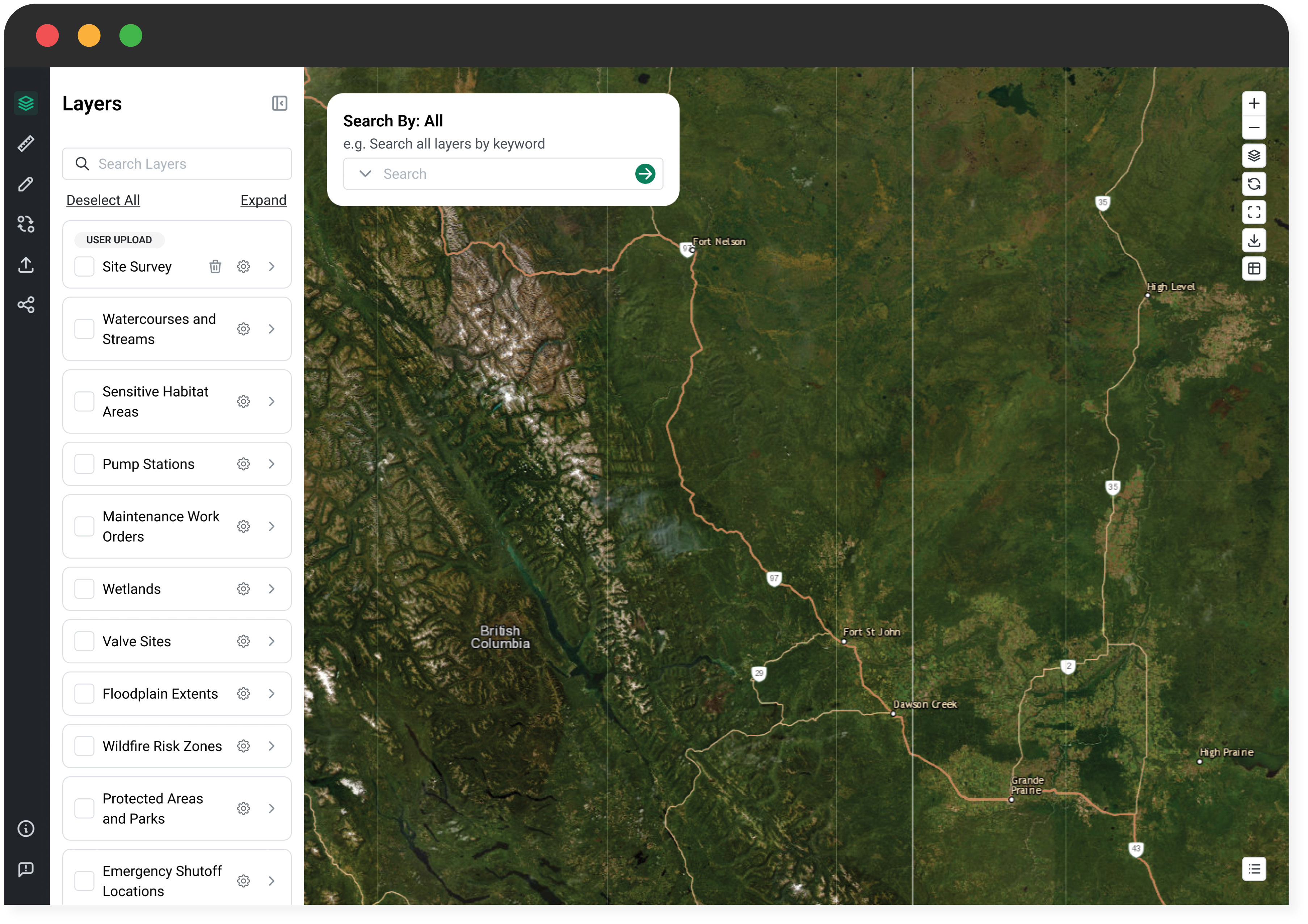
I discovered the core issue wasn't a missing feature. It was a misalignment between the tool and the people who depended on it, made harder by how deeply it was embedded in daily operations. Frequent users built workarounds instead of using what the platform already offered, screenshotting the map to mark it up elsewhere, while less frequent users missed features entirely, like the map export tool. The interface compounded both problems, with an overstuffed map layers panel, no way to reset to a default view, actions that never confirmed they'd worked, and information that was hard to locate or filter.
Approach
The application pulled from data that stayed on the legacy platform, so the build replaced only the front end, not the systems underneath it. Once requirements were gathered, I had to decide what belonged in the first version and what could wait. I prioritized what was most critical to how people across the company actually worked, and pushed what mattered less to daily workflows into a later phase. The trade-off was a leaner initial release that left out some capabilities people wanted.
I used AI throughout the project, synthesizing interview transcripts into a themed set of pain points and priorities that shaped where design effort went first, and powering a custom skill I built to generate GitHub tickets, cutting real time out of work I'd otherwise have done manually.
I ran task-based usability testing after the build. This surfaced more bugs and gaps than internal testing had caught. AI-assisted rapid iteration let me move through those fixes quickly, and I resolved them in order of impact as the project's final phase.
Solution
I designed around one governing principle. A feature only creates value if people can actually find and use it. Native annotation tools let people mark up the map directly, closing the gap that had frequent users screenshotting it into another app to do the same thing. The map layers panel, which controls what data shows on the map and how, got redesigned, surfacing what people needed instead of burying it behind nested menus. A one-click reset returned people to the default view, and clearer feedback let people know when an action had completed. Better search and an overall interface overhaul closed the remaining gaps, so features stopped hiding in plain sight.
Impact
The new application delivered on the original business case, keeping the same underlying data while replacing the rigid components of the legacy platform with something that scales and adapts as the business changes. Search and layer management stood out as the clearest wins, echoed by usability testing participants and the client alike. As one participant put it, "Definitely an improvement, it was so cryptic before." The project also taught me to work more closely with the data side of a build from day one, a practice I now bring to requirements gathering on any project with deep technical dependencies.